Samuel Alvar
Los renglones torcidos de DiosSamuel Alvar is the director of the Nuestra Señora de la Fuentecilla Psychiatric Hospital, an antipsychiatrist, and the figure on whom Alice Gould’s covert investigation depends. He knows that she is not simply the patient her file describes: he has agreed to help her investigate a murder while she enters the hospital pretending to be paranoid. Yet the institution admits her under involuntary procedures, and Alvar’s authority becomes part of the confinement she later denounces. His character is built around that contradiction: a prospective ally whose assistance does not prevent him from exercising, or being implicated in, the hospital’s power over her.
Identity and Position
Alvar’s position is established before he appears in person. While he is away on vacation, the doctor E. Donadío’s private letter to him is opened by Teodoro Ruipérez, who considers himself authorized to do so in the director’s absence. The letter contains clinical suggestions and characterizes Alice as someone who answers everything, even by lying and contradicting herself. Its intended recipient, however, is Alvar: the clinicians regard Alice as his direct patient and defer treatment decisions until he returns. His absence therefore has practical consequences from the beginning, leaving the hospital’s staff to manage her admission while reserving the question of her treatment for him.
Alvar is also linked to Raimundo García del Olmo, Alice’s client. He is described as Raimundo’s intimate friend and as the person who can facilitate information about the suspects. This connection explains why his role exceeds that of a hospital director: he is positioned at the junction of Alice’s psychiatric cover and her investigative assignment. The promise of access to information makes him a collaborator in the case, while his office gives him authority over the setting in which Alice must conduct it.
The Agreement with Alice
Alvar is the one person Alice knows to be aware that she is entirely healthy and pretending to be mentally ill. He advised her to feign paranoia, a choice that suits her investigative purpose because the role allows her to reason and perform the ordinary duties of her profession without having to imitate the outward behavior associated with other disorders. Her confidence in that arrangement is so consuming that his name becomes a recurring fixation in her thoughts. The arrangement depends on secrecy: Alice must be accepted as a patient by the very institution whose director knows her presentation is false.
The terms of that alliance become especially pointed during Alvar’s vacation. Alice asks when he will return and learns that he has only just begun a roughly five-week absence. When the staff explain that her admission papers include Donadío’s private letter to Alvar, they tell her that no treatment will be started until the director is back. The delay is more than an administrative interval. It makes Alvar’s eventual decision central to Alice’s medical status, while leaving her inside the hospital under a diagnosis and admission process that she believes are part of a voluntary investigation.
Later, the novel confirms that Alvar’s offer of help was not wholly imaginary. Donadío had in fact come to the hospital and discussed Alice with him, warning that she was a genuine paranoiac who did not know she was ill and wanted to enter the institution while simulating paranoia. Alvar nevertheless offered to assist the investigation she believed she was undertaking. That offer was then conveyed to Alice by the man she took to be Raimundo García del Olmo. The disclosure complicates her certainty: Alvar had agreed to help, but Alice’s understanding of who had made the promise and how it reached her was mistaken.
Authority and the Involuntary Admission
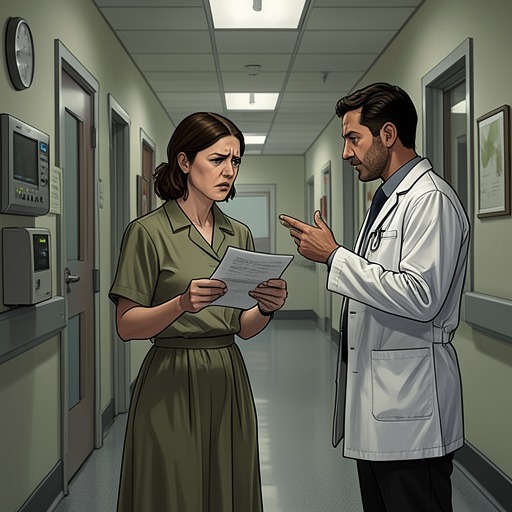
When Alvar returns, Alice insists that she is not his patient, has entered of her own accord, and is a professional detective. He answers by distinguishing the paperwork for voluntary admission from what appears in her file. A voluntary patient, he explains, would have signed a declaration requesting treatment, accompanied by Teodoro Ruipérez’s certificate of admission. Alice’s file instead follows the procedure for an involuntary case: a medical certificate from Donadío stating that she is ill and requires hospitalization, together with an application from her husband, Heliodoro Almenara, as her relative.
The distinction turns Alice’s supposed cover into a legal and institutional trap. Whatever she intended, the documents give the hospital a basis to treat her confinement as involuntary, and Alvar presents the discrepancy as a fact of the case rather than a misunderstanding he can simply undo. His explanation establishes the director’s power and the limits of Alice’s control over her own account. It also sharpens the conflict between the private agreement she believes she has with him and the official record that governs her stay.
Alvar’s clinical position is expressed in his account of how prior illness changes the effect of injury: a blow to a healthy arm causes less damage than the same blow to an arm already broken or afflicted by disease. The comparison frames the doctors’ task as one of interpreting present symptoms in light of an existing condition, rather than treating each statement as an isolated claim. In another explanation, he tells Alice that a medical interrogation differs from questioning by a journalist, police officer, prosecutor, or judge: the doctors do not seek to condemn her. These statements present a clinical ideal distinct from punishment, but they also underscore the doctors’ authority to define what Alice’s answers mean.
Confrontation and Institutional Conflict
Alice eventually accuses Alvar of having sacrificed her freedom to protect himself. Her theory is that a friend’s imprudence has placed him at risk of immediate dismissal, a tribunal of honor, and expulsion from his profession; to save his reputation and career, she argues, he has told Raimundo that the detective has escaped, died, or been discharged. Alvar looks at her for a long time and does not answer. His silence does not independently verify every part of her accusation, but the scene makes the personal cost of their alliance unmistakable: Alice sees the director not as the guarantor of their agreement but as the person who may have chosen institutional self-preservation over her liberty.
At a later encounter, Alice formally denies that the visitor claiming to be Raimundo García del Olmo is the doctor and asks the police for protection against what she calls her kidnapping. She directs a hard stare at Alvar; he holds her gaze and remains impassive. The exchange repeats the struggle over who has the authority to name reality. Alice challenges the visitor’s identity and her own status as a patient, while Alvar’s position lets him remain inside the official order she contests. Her proposal that the only effective route to freedom is to change the director makes that power structure explicit: escape need not mean flight if the authority keeping her confined can itself be displaced.
The conflict also sits within debate over psychiatric reform. Alice’s friend César Arellano cautions her against judging antipsychiatrists unfairly, crediting their criticism of old hospital systems with constructive reforms while arguing that their weakness is to think more like sociologists than doctors and to neglect the infrastructure needed to put their ideas into practice. He specifically defends removing bars as an excellent measure, while insisting on the need to build the necessary conditions first. Alvar is identified as an antipsychiatrist, placing him within this contested reformist outlook; the novel’s hospital, meanwhile, shows how ideals of liberty and clinical authority remain entangled in daily practice.
Public Defense and Legacy
When Alvar addresses the doctors, he complains that a damaging document about him has circulated through the hospital and stresses that it was written by a patient and signed by doctors. He proposes a transaction: replacing the document addressed to the minister of health with another he intends to present. The episode shows him responding to criticism not only as a clinician but as a director defending his standing among colleagues. His concern with the document’s authorship and the doctors’ signatures also echoes the novel’s larger conflict over whose account will be accepted as authoritative.
Alvar’s eventual standing is not reduced to either innocent mentor or simple jailer. The later confirmation that he really did offer Alice help restores a factual basis to the alliance she believed in, while the involuntary papers and her continued detention preserve the force of her grievance. Near the end, doctor Salvador Sobrino says that he believes Alvar was right; the silence that follows seems to challenge Alice’s claim that silence does not exist. Alvar thus remains present even when absent from the exchange: his judgment continues to divide the doctors, just as his earlier promise continues to divide Alice’s experience of him. The novel leaves that tension unresolved, making him a central figure in its question of whether clinical care can remain humane when the institution holding the patient also controls the terms of her freedom.